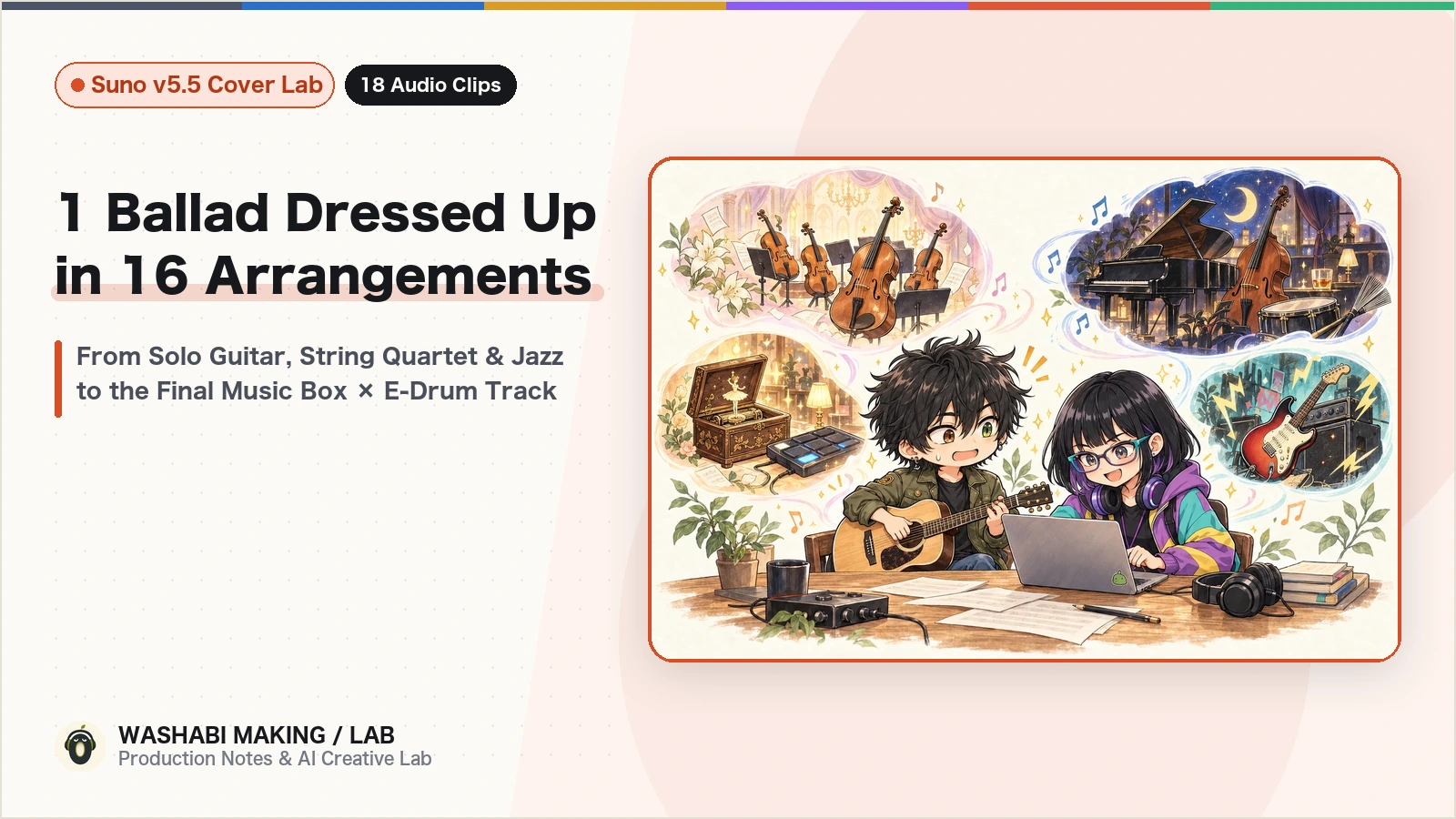
Hi, I'm Rey! I produce a 6-piece virtual rock band called WASHABI using a hybrid human + AI workflow.
Suno's Cover feature lets you upload your own demo recording and have AI re-perform the song in a completely different arrangement while keeping your original melody intact.
When writing a new song, it's common to hit a fork in the road: "The melody and lyrics are locked in, but what instrumentation and arrangement actually suit this song best?"
When we started working on our track "#034 Lamp" (a quiet song of encouragement), my initial plan was a simple acoustic guitar ballad with a few supporting instruments.
But since we had a rough demo ready, I decided to run a controlled experiment with Suno Cover: keep the source audio, lyrics, and slider values 100% identical, and swap only the English Style prompt across 16 different arrangements.
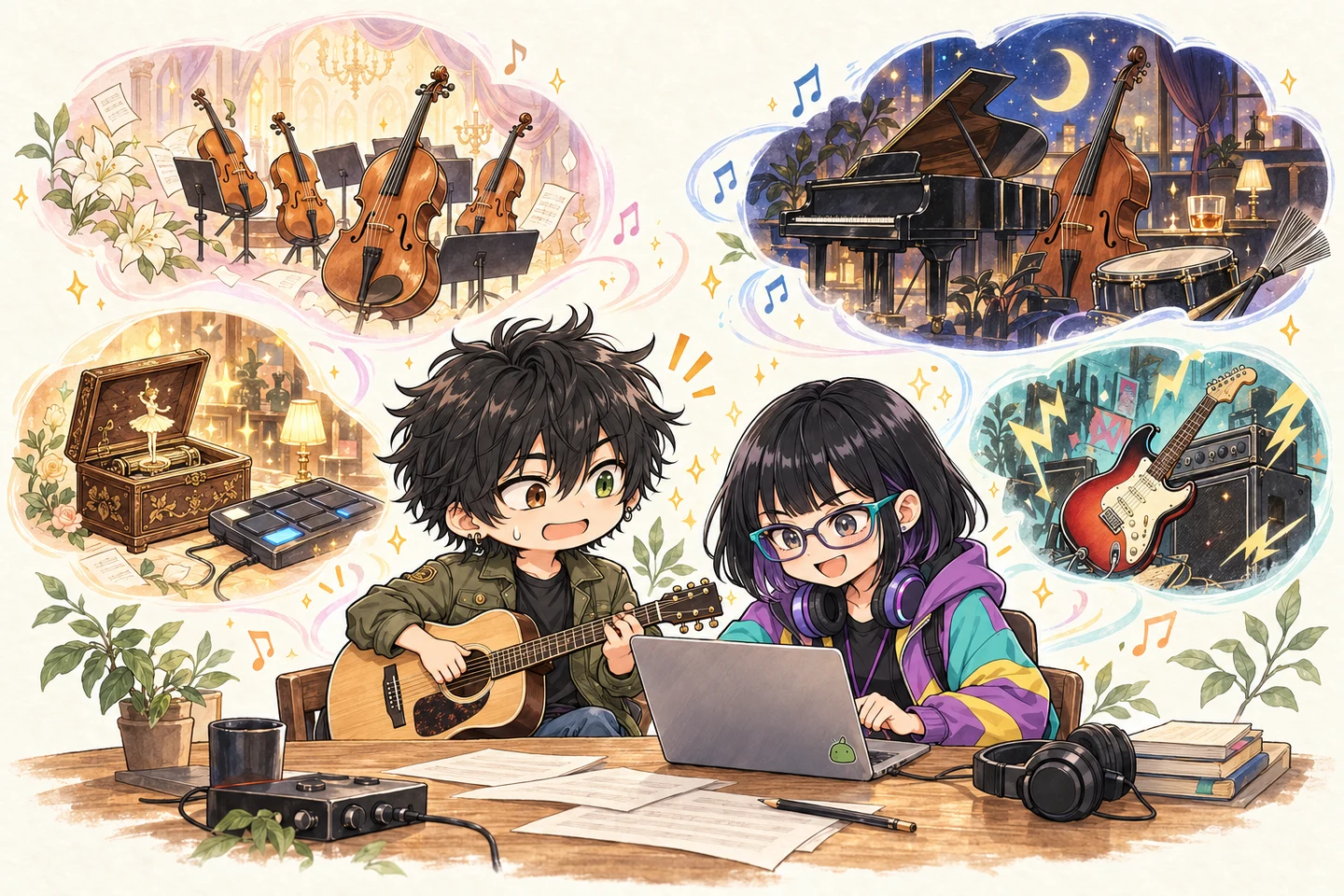
To my surprise, the winner wasn't the acoustic guitar arrangement I originally envisioned. Instead, a wildcard "Music Box Lullaby (D1)" with soft electronic drums added ("D1b") clicked immediately—and became the foundation for our final master track!
In this post, you can listen to the original demo, all 16 Cover variations, and the final finished master using synced A/B audio players, while we break down three key takeaways:
- Why writing
Only voice and one guitarstill lets strings sneak in—and the exact prompt rewrite that isolated a single acoustic guitar - How a wildcard "Music Box" experiment evolved into our final release
- What transforms dramatically vs. what stays locked in Suno Cover (at 25% Audio Influence)
- Suno MCP (Beta) Hands-On (EN): Generating 60s Songs, Lo-fi Covers & Free Audio Analysis Directly from Chat
- 3D Room Set for "#034 Lamp" MV (EN): Consistent Rooms & Props in AI Video: How We Built the "#034 Lamp" MV in Blender + H3
1. The Starting Point: Our Rough Demo (`lamp_v0.5`)
First, here is the source demo (lamp_v0.5) that we fed into Suno Cover for all 16 tests.
It features WASHABI's male vocalist Go singing over a quick, rough 1-minute backing track programmed in Logic Pro (acoustic guitar, electric piano, upright bass, and drums).
We uploaded this exact 1-minute audio file to Suno Cover and dressed it up in 16 different Style prompts.
Quick Taste: Compare 5 Representative Takes First!
Before diving into the details, compare 4 standout Cover variations (Solo Acoustic Guitar, Late-Night Jazz Trio, 90s J-Rock Power Ballad, and Music Box + Electronic Drums) alongside our Final Master Track!
*Note: Because different arrangements generate intros of different lengths, all comparison clips below have their intros trimmed so they start at the exact same bar (First Chorus through Interlude, ~23.5s). Click any tab while playing to switch arrangements seamlessly at the exact same beat!*
Even though every single take came from the exact same rough demo, swapping only the Style prompt transformed the track from a bare acoustic performance into a smoky jazz club trio, a 90s rock stadium ballad, and a dreamy music-box electronica piece.
2. Experimental Setup: What We Locked vs. What We Changed
To isolate the effect of the Style prompt alone, we locked every other parameter in Suno Cover across all 16 runs:
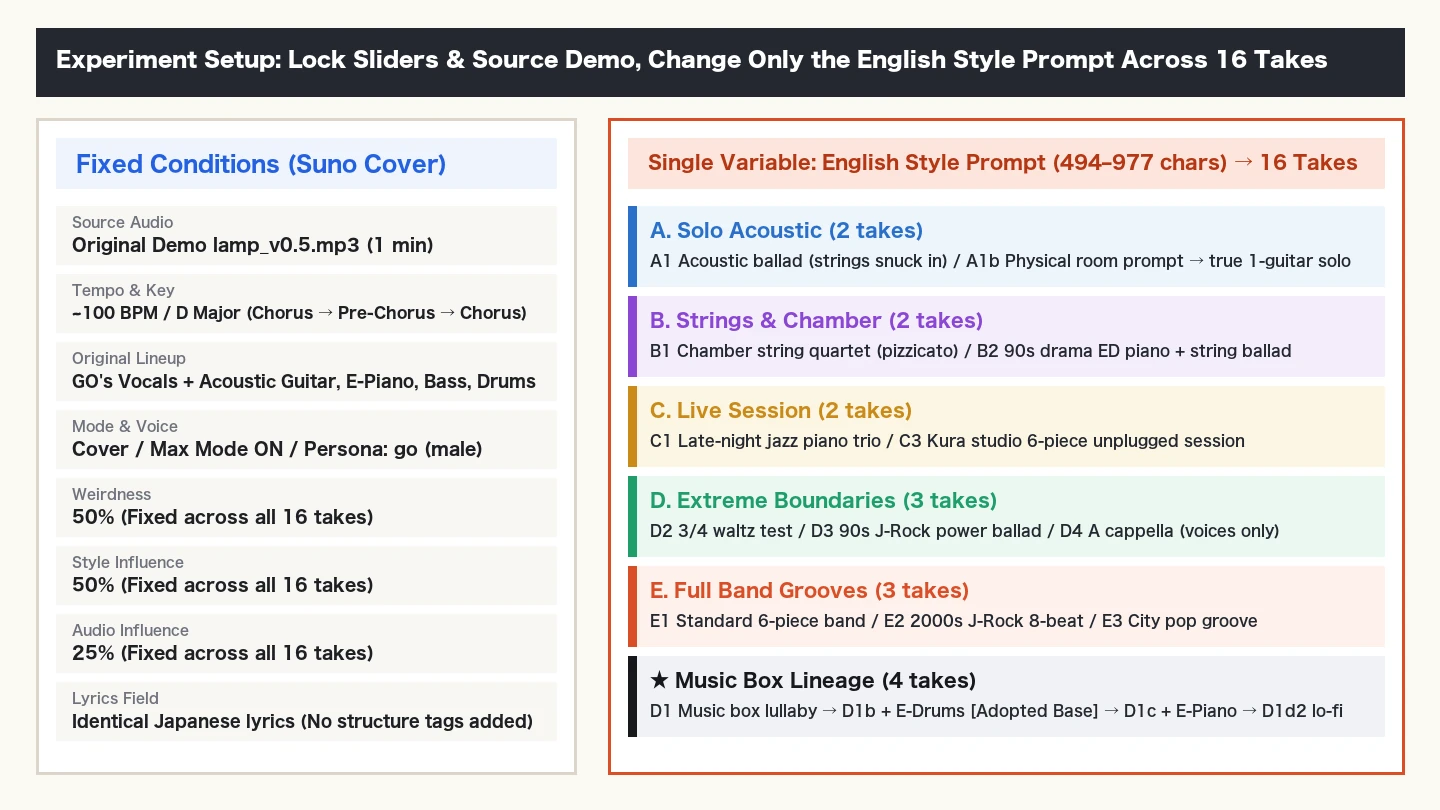
- Source Audio:
lamp_v0.5.mp3(Chorus 1 → Bridge → Chorus 2 structure / D major / ~100 BPM) - Mode & Voice: Cover (Max Mode: ON / Length: Auto / Variation: Standard) + Persona
go(Male vocal) - Lyrics Field: Identical Japanese lyrics across all 16 runs (no structural
[ ]tags added) - Three Sliders: Weirdness
50%/ Style Influence50%/ Audio Influence25%
With those settings frozen, we generated 16 variations by changing only the English text in the Style box.
3. Discovery #1: Why "Only Voice and One Guitar" Still Triggers Strings—and How to Fix It
The most practical prompting lesson from this experiment was how to strip an arrangement down to a single instrument (solo acoustic guitar + vocal).
In my first attempt (A1), I explicitly wrote:Only voice and one steel-string acoustic guitar throughout.
Yet as soon as the track played, lush orchestral strings crept into the background anyway.
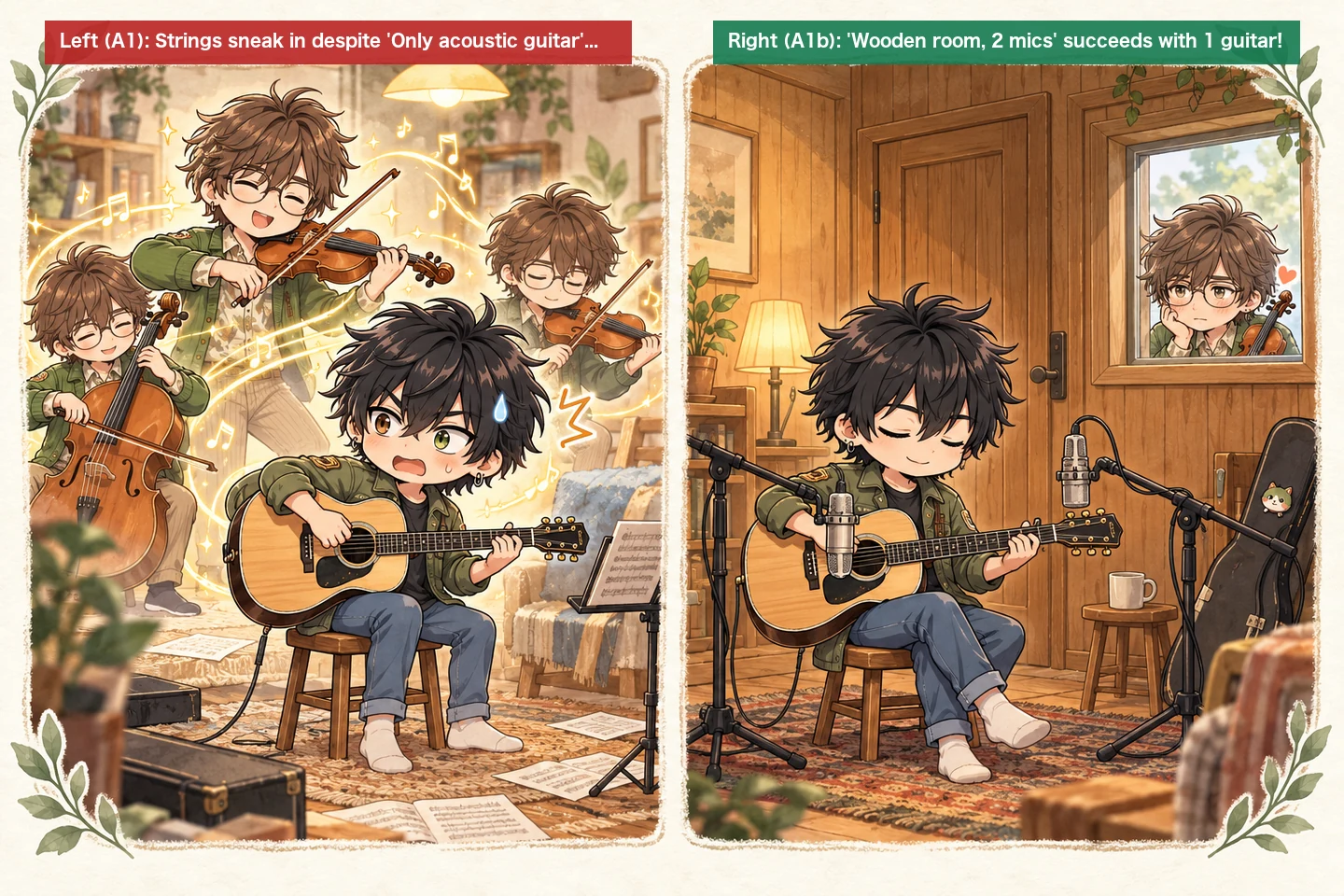
When I rewrote the prompt as A1b, the strings vanished completely, leaving purely one acoustic guitar and voice!
Listen to the difference between A1 and A1b with synced playback:
The 4 Changes We Made from A1 to A1b
Comparing the exact English prompts for A1 and A1b side by side shows why A1 triggered strings and how A1b prevented them:
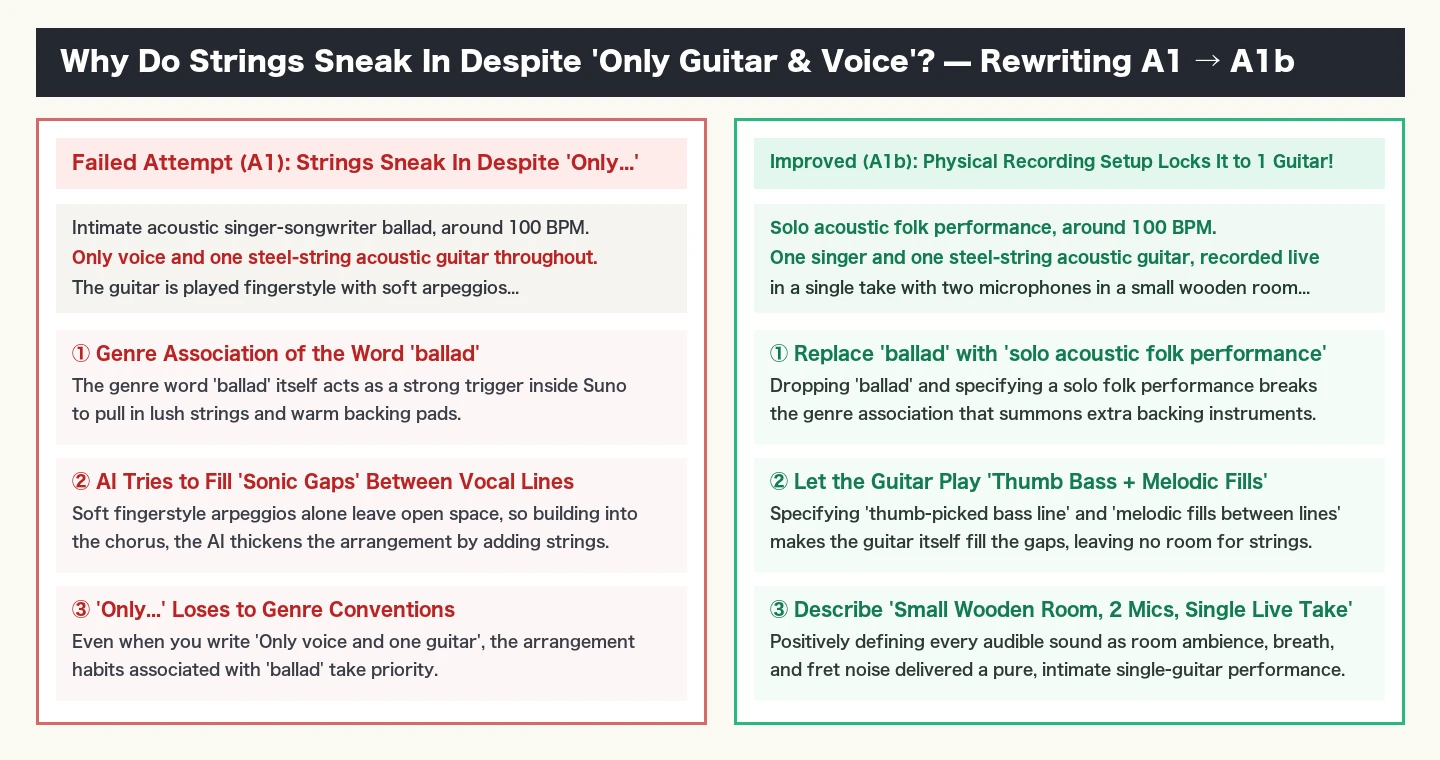
[A1: Prompt where unwanted strings crept in]
Intimate acoustic singer-songwriter ballad, around 100 BPM, gentle and unhurried.
Only voice and one steel-string acoustic guitar throughout.
The guitar is played fingerstyle with soft arpeggios, warm low strings, open strings ringing and natural fret noise.
Straightforward, honest male vocal with a warm, slightly sweet tone, close-miked and tender, sung as if to one person in a quiet room.
The middle section stays hushed; in the final chorus the guitar shifts to light strumming and the voice opens up a little without pushing.
Small room ambience, light reverb, honest and unpolished. Preserve the original vocal melody, Japanese lyrics and compact one-minute structure. End on a single let-ring guitar chord.[A1b: Prompt that successfully isolated a single acoustic guitar]
Solo acoustic folk performance, around 100 BPM.
One singer and one steel-string acoustic guitar, recorded live in a single take with two microphones in a small wooden room.
The guitar carries all of the accompaniment: fingerpicked arpeggios, a thumb-picked bass line, and short melodic fills that answer the voice between lines.
Straightforward, honest male vocal with a warm, slightly sweet tone, close and tender.
In the final chorus the same guitar switches to soft strumming and the voice opens up a little.
Bare, dry and intimate; the room, the breath and the fret noise are the only other sounds. Like a home demo played for one listener. Preserve the original vocal melody, Japanese lyrics and compact one-minute structure. End on a single let-ring guitar chord.Here are the four specific changes that made the difference:
- Replaced
"ballad"with"Solo acoustic folk performance": In Suno's training associations, the wordballadstrongly pulls in cinematic strings and synth pads. Framing the genre as a solo folk performance removed that bias. - Described a physical recording setup (
recorded live in a single take with two microphones in a small wooden room): Instead of relying on negative instructions ("no other instruments"), describing a physical two-mic live capture in a small wooden room leaves no acoustic space for an orchestra. - Assigned the guitar to fill the sonic gaps (
a thumb-picked bass line, and short melodic fills that answer the voice between lines): When there is empty space between vocal phrases or in the low end, Suno naturally tries to fill the arrangement with pads or strings. Telling the single guitar to handle the bass line with the thumb and play short melodic turnarounds kept Suno from adding extra instruments. - Defined the remaining soundscape positively (
the room, the breath and the fret noise are the only other sounds): Naming non-musical acoustic details as "the only other sounds" locked out background instrumentation.
4. Category-by-Category Audio Comparison (Synced at First Chorus)
Now let's listen through the remaining arrangements by category. All clips are aligned to the first chorus so you can flip tabs mid-playback!
① Strings & Orchestral (B1: String Quartet / B2: 90s J-Pop Ballad)
First, two takes where strings take center stage (*Note: B2 generated a 14-second intro, which we trimmed here to sync the vocal entry with B1*).
[B1: String Quartet (Chamber Pop)]
Chamber pop ballad with a string quartet, around 100 BPM. Two violins, viola and cello are the only accompaniment: the cello carries the bass line with long bowed notes, viola and second violin play soft pulsing chords, and the first violin answers the voice with short countermelodies. Gentle pizzicato in the middle section, then warm sustained legato swells in the final chorus. Straightforward, tender male vocal, close-miked and unforced. Intimate small-hall acoustics, wood and rosin detail, restrained and elegant. Preserve the original vocal melody, Japanese lyrics and compact one-minute structure. End on a long, quiet held string chord.

[B2: 90s J-Pop Piano + Strings Ballad]
Classic 1990s Japanese pop ballad, around 100 BPM. A grand piano leads with flowing arpeggios; a lush string section rises behind the voice, with soft fretless bass and gentle brushed drums entering after the first chorus. Straightforward, sincere male vocal with a warm, slightly sweet tone, clear diction and emotional sustain. The middle section builds with a rising string line and a soft timpani roll into a brighter, fuller final chorus with full strings, piano octaves and a short soaring violin countermelody. Polished studio sound, wide stereo strings, warm reverb. Preserve the original vocal melody, Japanese lyrics and compact one-minute structure. End with a gentle piano and string ritardando on the final word.
② Live Session Vibes (C1: Late-Night Jazz Trio / C3: Storehouse Unplugged)
Next are two takes designed around the feel of musicians playing together in the same room.
[C1: Late-Night Jazz Piano Trio]
Late-night jazz ballad by a piano trio, around 100 BPM with a relaxed swing feel. A warm grand piano with rich extended chords and gentle fills between vocal lines, upright bass walking softly, brushes swirling on the snare. Smoky, intimate male vocal, laid back and slightly behind the beat. A brief piano phrase bridges the middle section and the final chorus. Recorded live in the room, players listening to each other, small club ambience. Preserve the original vocal melody, Japanese lyrics and compact one-minute structure. End with a soft piano tag over a held bass note.

[C3: 6-Piece Unplugged Session]
Unplugged band session recorded live in an old wooden storehouse studio, around 100 BPM. An acoustic guitar strumming with a second acoustic guitar picking fills, a warm acoustic bass, cajon and soft brushes for drums, and a toy piano and glockenspiel adding small sparkling melodies. A straightforward, warm male lead vocal up front; a clear, soft female harmony vocal joins only in the final chorus, and the band adds light hand claps near the end. Relaxed and smiling, six friends playing in a circle, natural room sound with a little wooden reverb. Preserve the original vocal melody, Japanese lyrics and compact one-minute structure. End with a loose final strum and a single ringing glockenspiel note.
③ Music Box Evolution (4 Variations + Final Master: How Wildcard "D1" Became Our Official Track!)
This was the highlight of the entire experiment.
Just to test how far Suno Cover could stretch the sonic palette, I wrote D1 (Music Box Lullaby) with celesta and felt piano.
The moment I heard it, the delicate, slightly wistful bell texture captured the heart of "#034 Lamp" better than any of our guitar takes!
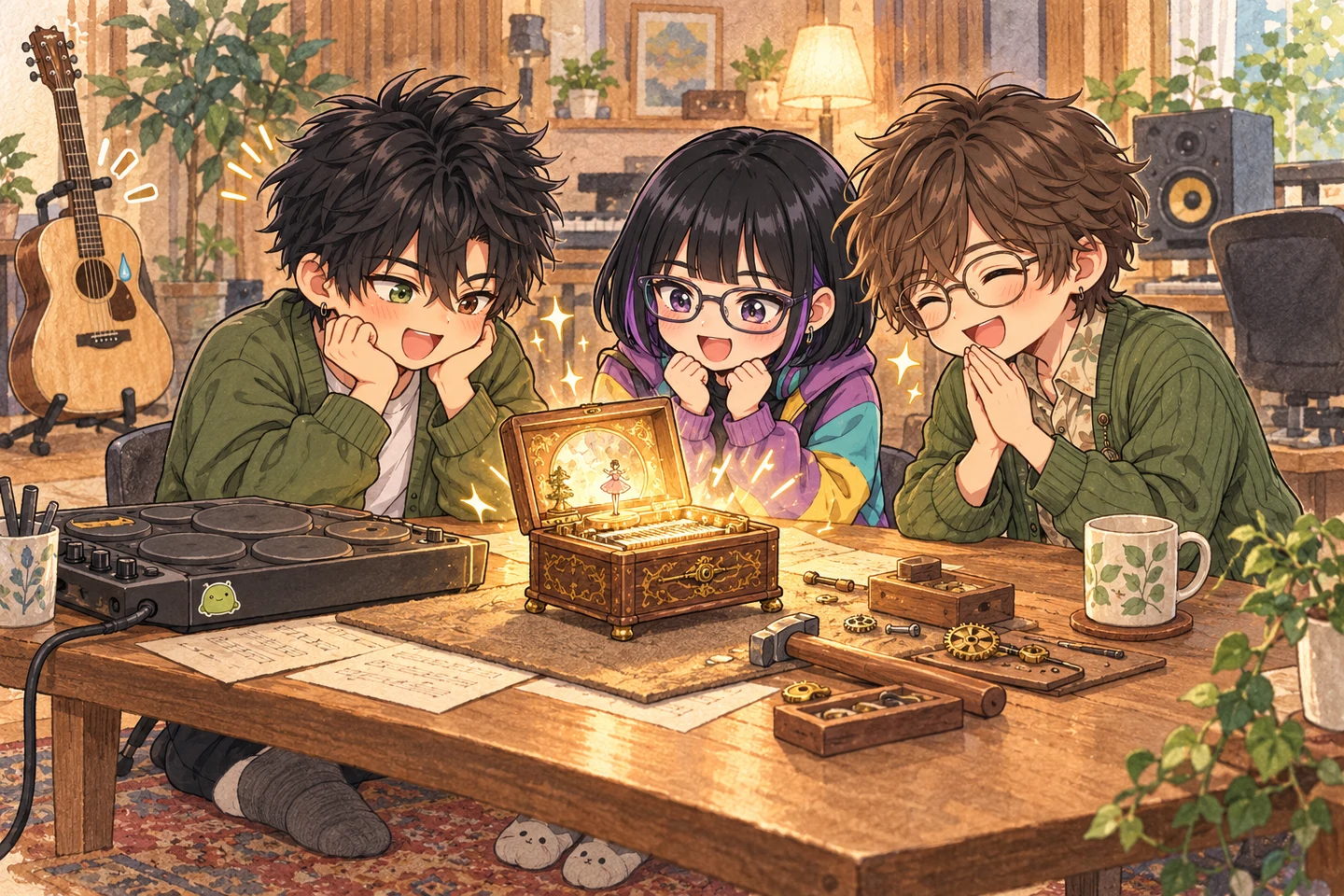
From D1, we branched out step by step: adding a soft electronic drum machine (D1b), adding Rhodes electric piano (D1c), and pushing it into lo-fi hip-hop (D1d2). Ultimately, D1b had the best balance—so we used D1b as our foundation, layered marimba and electric piano via Suno Studio, and added workshop foley percussion in Logic Pro to create the ★ Final Master!
[D1: Music Box Lullaby]
Music box lullaby, around 100 BPM, gentle and floating. A delicate music box and celesta play the chords and echo the melody, with a soft felt piano underneath and a faint warm synth pad like lamplight. Very quiet, close, whisper-soft male vocal, as if singing a child to sleep. A light vinyl crackle in the background. Minimal, dreamy, nostalgic. Preserve the original vocal melody, Japanese lyrics and compact one-minute structure. End with the music box slowing down as if winding to a stop.

[D1b: Music Box + Soft Electronic Beats (★ Chosen Base Prompt)]
Music box lullaby with soft electronic beats, around 100 BPM, gentle and floating. A delicate music box and celesta play the chords and echo the melody, with a soft felt piano underneath and a faint warm synth pad like lamplight. A quiet, rounded electronic drum machine joins from the middle section: a muted kick, soft rim clicks and a light closed hi-hat, sitting low in the mix and never louder than the music box. In the final chorus the beat adds a gentle snare and a soft sub-bass pulse. Very quiet, close, whisper-soft male vocal, as if singing a child to sleep. A light vinyl crackle in the background. Minimal, dreamy, nostalgic. Preserve the original vocal melody, Japanese lyrics and compact one-minute structure. The beat drops out for the last bar, and the music box slows down as if winding to a stop.

[D1c: Music Box + Electronic Beats + Electric Piano]
Music box lullaby with electric piano and soft electronic beats, around 100 BPM, gentle and floating. A delicate music box and celesta echo the melody on top, while a warm Rhodes-style electric piano with a soft tremolo plays the chords underneath, joined by a faint warm synth pad like lamplight. A quiet, rounded electronic drum machine joins from the middle section: a muted kick, soft rim clicks and a light closed hi-hat, sitting low in the mix. In the final chorus the electric piano plays fuller chords and the beat adds a gentle snare and a soft sub-bass pulse. Very quiet, close, whisper-soft male vocal, as if singing a child to sleep. A light vinyl crackle in the background. Minimal, dreamy, nostalgic. Preserve the original vocal melody, Japanese lyrics and compact one-minute structure. The beat drops out for the last bar, leaving the music box and one last electric piano chord.

[D1d2: Lo-fi Hip-Hop Lullaby]
Lo-fi hip-hop lullaby with a music box and electric piano, around 100 BPM with a laid-back, slightly swung groove. A delicate music box and celesta echo the melody on top, while a warm, slightly detuned Rhodes-style electric piano with a soft tremolo plays jazzy chords underneath. Soft but clear boom-bap drums sit behind the beat: a round, punchy kick, a crisp snare with a little room, and clean, airy hi-hats, clearly audible. The first chorus has only light rim clicks and hi-hats, the kick and snare join in the middle section, and the final chorus adds a warm, round bass. The lo-fi haze lives in the keys and the background, not the drums. Very quiet, close, whisper-soft male vocal, the words still clear. Light tape saturation, subtle wow and flutter on the keys, vinyl crackle. Cozy and nostalgic. Preserve the original vocal melody, Japanese lyrics and compact one-minute structure. End with the beat dropping out and the tape slowing to a stop under the music box.
④ Boundary Tests (D2: 3/4 Waltz Attempt / D4: Full A Cappella)
How far can Suno Cover bend the fundamental rules of the source audio? We tested two extremes: changing the meter from 4/4 to 3/4 waltz, and stripping out every instrument for a pure vocal a cappella arrangement.
[D2: 3/4 Waltz Attempt]
Tender acoustic waltz in 3/4 time with a lilting, swaying feel. Accordion breathing soft chords, acoustic guitar playing a bass note on beat one and light strums on two and three, a gentle violin melody between vocal lines, and a light upright bass. Warm, kind male vocal phrased gracefully over the triple meter. A small town in the evening, lamplight in a window, nostalgic and warm. Keep the original Japanese lyrics and a recognizable melody contour, adapted to waltz time, compact one-minute structure. End with a slow final bar and a held accordion chord.

[D4: A Cappella Arrangement]
A cappella vocal arrangement, around 100 BPM. Only human voices: a straightforward, warm male lead singing the melody, soft "oo" and "ah" harmony pads in four parts, a gentle vocal bass line and light finger snaps for the pulse. The harmonies stay sparse in the first chorus and blossom in the final chorus, with a high female voice floating above. Intimate, warm, a small vocal group in one room. Preserve the original vocal melody, Japanese lyrics and compact one-minute structure. End on a soft, perfectly tuned held chord.
⑤ Band Arrangements (D3: 90s J-Rock / E1: Standard 6-Piece / E2: 2000s 8-Beat / E3: City Pop)
Finally, here are four full-band takes comparing different eras and grooves:
- Takeaway on Band Prompts: Writing a neutral "standard band" prompt (
E1/E2) produced clean but somewhat generic results. Giving Suno strong era and tonal anchors—like 1990s J-Rock Power Ballad (D3) or City Pop with Rhodes & off-beat guitar (E3)—yielded far more character and musicality.
[D3: 1990s J-Rock Power Ballad]
1990s Japanese rock power ballad, around 100 BPM. Clean, chorus-tinged electric guitar arpeggios and soft piano carry the first chorus, joined by warm bass and steady live drums in the middle section. The final chorus opens up with thick overdriven rhythm guitars, a crash-cymbal lift and a singing, melodic lead guitar answering the vocal. Straightforward, passionate yet gentle male rock vocal with a slight rasp and a sweet tone, warm and sincere, never shouting. Big roomy drum reverb, warm analog tone. Preserve the original vocal melody, Japanese lyrics and compact one-minute structure. End with a sustained lead guitar note over a ringing final chord.

[E1: Standard 6-Piece Band Ballad]
Warm Japanese band ballad, around 100 BPM, a six-piece rock band playing gently. A clean electric guitar playing arpeggios and a second guitar adding soft volume swells, round electric bass, live drums with a soft kick, cross-stick snare and light hi-hats, and warm electric piano with a subtle synth pad underneath. Straightforward, honest male lead vocal with a warm, slightly sweet tone. The first chorus is restrained, the middle section adds fuller drums and moving bass, and the final chorus opens up with open snare hits, strummed guitars and a clear female harmony vocal. Natural band mix with every player audible, not overproduced. Preserve the original vocal melody, Japanese lyrics and compact one-minute structure. End with the whole band landing on one held chord.

[E2: 2000s 8-Beat Guitar Rock]
Mid-tempo 2000s Japanese guitar rock, around 100 BPM with a steady straight eight-beat groove. Bright, crunchy electric guitars strumming open chords, a jangly clean lead guitar playing a simple hook between vocal lines, punchy bass locked to the kick, and tight live drums with a driving hi-hat. Straightforward male vocal, warm and sincere, singing with quiet conviction rather than shouting. Fresh and hopeful, like walking home at dusk, with the energy rising slightly into the final chorus after a short drum fill. Dry, punchy rehearsal-room band sound. Preserve the original vocal melody, Japanese lyrics and compact one-minute structure. End with a ringing guitar chord and a final snare hit.

[E3: Mellow City Pop Band]
Mellow Japanese city-pop band ballad, around 100 BPM with a gentle laid-back groove. Rhodes electric piano chords, a clean guitar softly cutting on the off-beats, a melodic fingerstyle bass, tight dry drums with a soft snare, and light synth strings. Smooth, warm male vocal, relaxed and close. Evening city lights, warm and nostalgic. The middle section stays light; the final chorus adds soft brass stabs and airy backing vocals. Polished analog studio sound. Preserve the original vocal melody, Japanese lyrics and compact one-minute structure. End with a sustained Rhodes chord and a soft bass slide.
5. Summary: What Changes vs. What Stays in Suno Cover (Plus All 17 Tracks in One Player!)
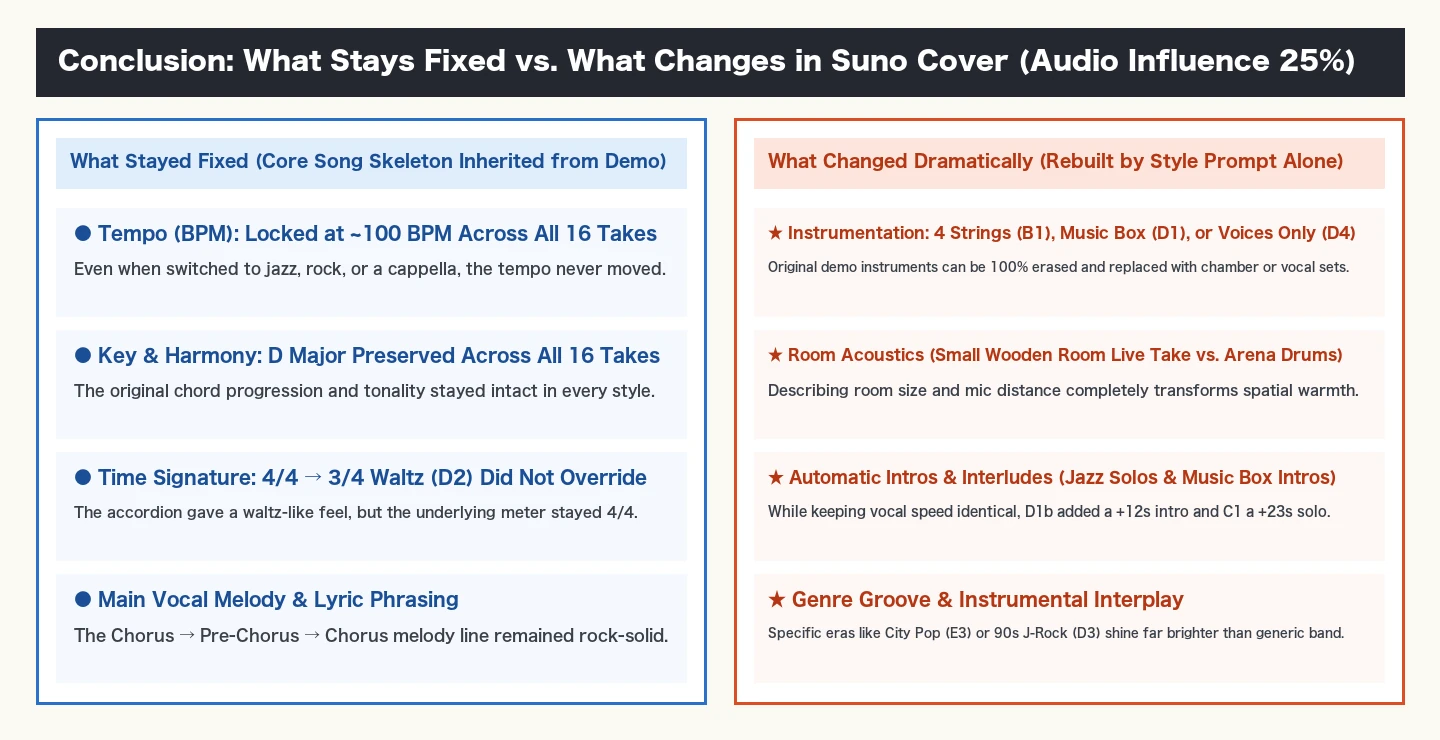
Here is a summary of what Suno Cover (at Audio Influence: 25%) can freely transform versus what stays anchored to your source demo:
- What Changes Dramatically via the
StylePrompt: - Instrumentation & Sonic Palette: From solo acoustic guitar (
A1b), string quartet (B1), and jazz trio (C1) to music box + electronic beats (D1b) and zero-instrument a cappella (D4). - Groove & Accompaniment Density: Swing jazz feel, straight 8-beat rock, off-beat City Pop funk, or accordion waltz sway.
- Vocal Delivery & Breathiness: Intimate whisper-soft lullaby singing (
D1) vs. passionate 90s rock sustain (D3). - Intro / Outro Length: Even with the same 1-minute source, prompts like
B2(90s pop ballad) automatically added a 14-second dramatic intro.
- What Remains Locked to the Source Demo:
- Core Vocal Melody & Harmonic Progression: The melody contour and chord changes stay faithful to
lamp_v0.5across every single genre. - Section Proportions & Tempo (~100 BPM): The relative timing of Chorus 1 → Bridge → Chorus 2 remains virtually identical (which is why all 17 tracks can be beat-synced in the player below!).
- Underlying Time Signature (4/4): Even when explicitly prompted for
3/4 waltz time(D2), the structural bar grid stayed in 4/4 while adapting the surface rhythm.
Finally, here is the complete 17-track master player containing our Final Master and all 16 Cover experiments, all synced at the first chorus. Click around while playing to hear how far a single 1-minute demo can travel!